The question every Covington homeowner eventually asks
A leak shows up after a spring storm, or a section of shingles starts looking rough, and the question arrives: is this a repair, or is this the beginning of a new roof? It is one of the most consequential decisions a homeowner makes, because the two answers differ by tens of thousands of dollars — and because both wrong answers are expensive. Replacing a roof that had years of repairable life left wastes money. Repairing a roof that is fundamentally done wastes money too, just more slowly, one patch at a time.
This guide lays out how we actually make that call for homes in Covington and across St. Tammany Parish: what makes repair the right answer, what tips the decision toward replacement, and the local factors that shift the math on the Northshore.
When repair is the right call
Repair is the right answer more often than storm-season door knockers would have you believe. A roof is a system of components with different lifespans, and one failed component does not mean a failed system. Repair usually makes sense when the damage is localized, recent, and on a roof with meaningful life left. Common examples we see in Covington:
- Wind-lifted or missing shingles in one area. A gust peels a patch of shingles on one slope while the rest of the roof stays sealed. If matching shingles are available and the surrounding shingles are still flexible, this is a straightforward repair.
- Failed flashing or pipe boots. Cracked neoprene pipe boots and lifted flashing around chimneys cause a large share of the leaks we diagnose, and they can fail on a roof that is otherwise healthy. These are component repairs, not roof problems.
- Tree limb punctures. Covington's tree canopy is part of why people live here, and it is also the source of many single-point roof injuries. A puncture from a falling limb is repairable if the decking damage is contained.
- A single persistent leak with a findable source. One leak, traced to one cause, fixed once — that is a repair success story.
The common thread: the problem has a boundary. A good repair on a mid-life roof restores the system, and you should expect the repaired area to last as long as the roof around it.
When replacement is the smarter investment
Replacement becomes the honest recommendation when the roof's problems stop having boundaries. The signals we weigh most heavily:
- Age at or past the design life. Most architectural shingle roofs in our climate deliver somewhere in the range of 15 to 25 years depending on ventilation, installation quality, and sun exposure. A leak on a 22-year-old roof is rarely a lone problem; it is the first of a series.
- Widespread granule loss and brittleness. When shingles across multiple slopes have shed their granules or crack when lifted, the roof covering has aged out everywhere at once. Repairs to brittle shingles often break more than they fix.
- Repeat leaks in different places. The second and third leak in different locations tells you the pattern: you are no longer fixing a defect, you are chasing a failing system.
- Soft or water-stained decking. If the plywood under the shingles has been wet enough for long enough to soften, the problem is below the surface, and shingle-level patching cannot reach it.
- Storm damage across multiple slopes. When wind or hail damage is spread over the roof rather than confined to one area, replacement is often both the correct scope and the one an insurer will actually evaluate.
A useful rule of thumb: when a repair estimate starts approaching a meaningful fraction of replacement cost on a roof past its midpoint, put that money toward the roof you will need soon anyway. Paying twice — once for patches, then again for the replacement — is the outcome to avoid.
What changes the math in Covington specifically
Two Northshore realities push this decision around more than homeowners expect.
Tree cover. Shaded Covington roofs are spared some UV aging but collect debris in valleys, hold moisture longer after rain, and live under limbs that become projectiles in wind events. If your roof is under heavy canopy, valleys and shaded slopes deserve extra scrutiny before deciding a problem is "localized."
Storm exposure and the insurance clock. Every roof here will be tested by tropical weather; the question is how old it will be when that happens. Insurers increasingly price and underwrite based on roof age, and some carriers get restrictive about roofs past 15 years. An aging-but-functional roof can be worth replacing a year or two "early" if it resets your insurability and lets you choose the timing, the contractor, and the materials — instead of making those decisions in the chaos after a storm. If you are already replacing, it is also the one moment to consider upgrading to a FORTIFIED roof, since the upgrade is dramatically cheaper during a replacement than after one.
How the decision actually gets made: inspection first
Everything above depends on facts about your specific roof — age, shingle condition slope by slope, decking condition, leak history — and those facts come from an inspection, not from the street. Ask the roofer to explain the findings and available documentation before recommending a scope. If you have not had an assessment recently, confirm the inspection scope and any fees; we wrote up exactly what a roof inspection covers so you know what a real one looks like.
Insist on that evidence standard with any contractor. "You need a new roof" should come with photos of your roof. So should "it's just a repair" — because underscoping is a real failure mode too, and a too-small repair that leaks again next spring is not a bargain.
A word on partial replacement
Homeowners sometimes ask about replacing just one slope — often the sun-beaten south face while the rest looks fine. It is occasionally the right call after concentrated storm damage, but as an aging strategy it usually disappoints: the slopes aged together, the new section will not match, and you carry the disruption and mobilization cost of a roofing project twice. If more than one slope is at the end of its life, price the full replacement before committing to a partial.
Conclusion: match the fix to the roof, not the fear
Repair when the problem has a boundary and the roof has life left. Replace when the problems are systemic, the roof has aged out, or the repair money would be better spent on the roof you will need within a few years anyway. The decision should follow from documented evidence, and the contractor giving it should be able to show you that evidence on your own roof.
All Star Roofing handles both roof repairs and full replacements for Covington and the wider Northshore, discuss the findings, proposed scope and documentation with the team. Request a free roof replacement estimate if replacement is being considered.
Frequently asked questions
When is a roof repair enough?
When the damage is localized, recent, and on a roof with meaningful life left — like wind-lifted shingles in one area, a failed pipe boot, or a single tree-limb puncture.
When should I replace instead of repair?
When problems are systemic: the roof is at or past its design life, shingles are brittle across slopes, leaks repeat in different places, or decking has gone soft.
Can I replace just one slope of my roof?
Occasionally after concentrated storm damage, but as an aging strategy partial replacement usually disappoints — the slopes aged together and you pay project mobilization twice.
How do I know which one my roof needs?
Ask for a property-specific assessment and an explanation of the findings. Confirm any inspection fees and documentation; All Star Roofing offers a free roof replacement estimate.
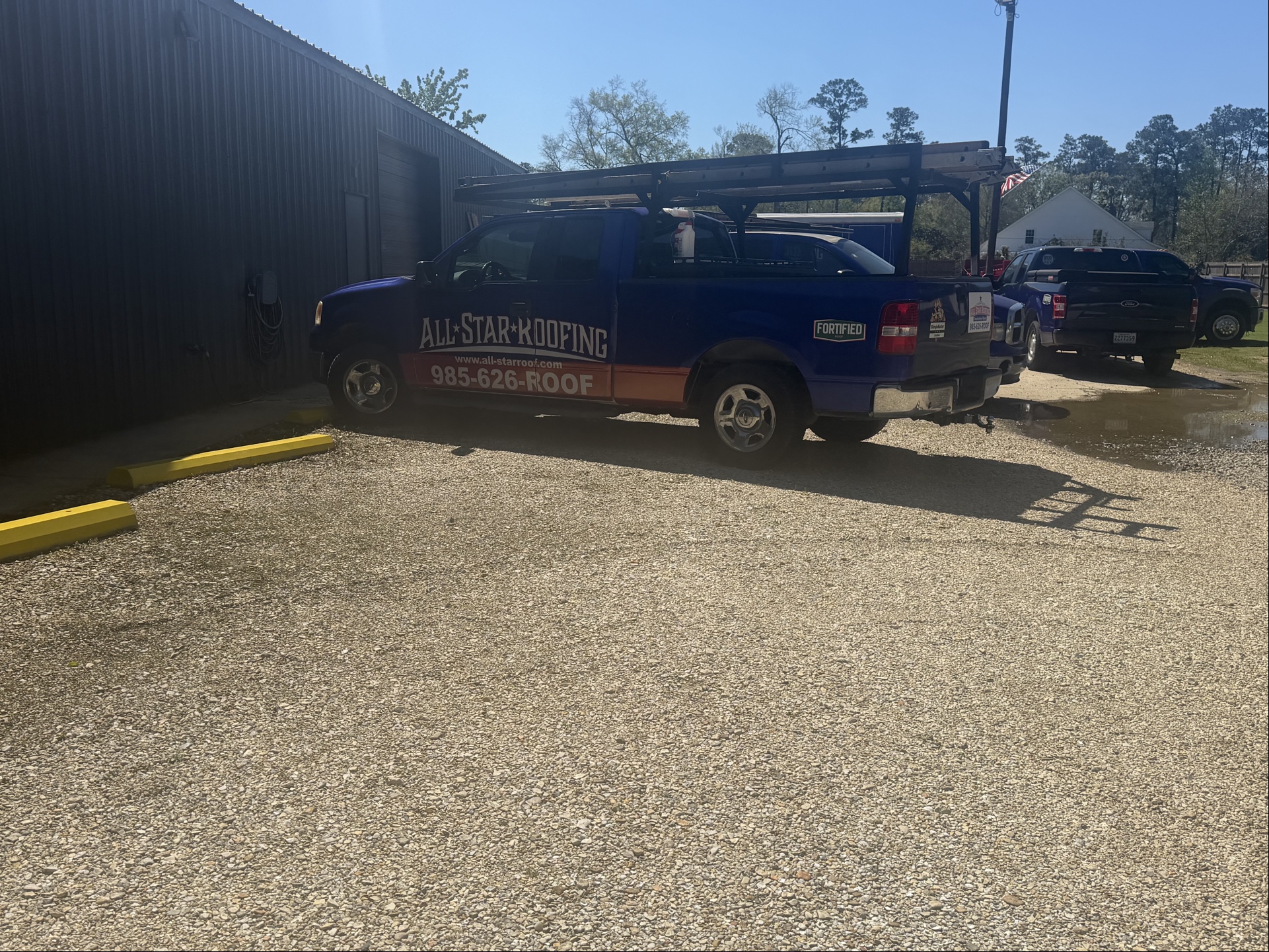
About All Star Roofing
All Star Roofing is a local Mandeville roofing company serving Saint Tammany Parish with roof replacement, roof repair, storm damage documentation, gutters, ventilation, and FORTIFIED roofing guidance.
Have a roof question about your Northshore home?
Call (985) 626-7663 or request a free roof replacement estimate from All Star Roofing in Mandeville.
Request Free Roof Replacement Estimate